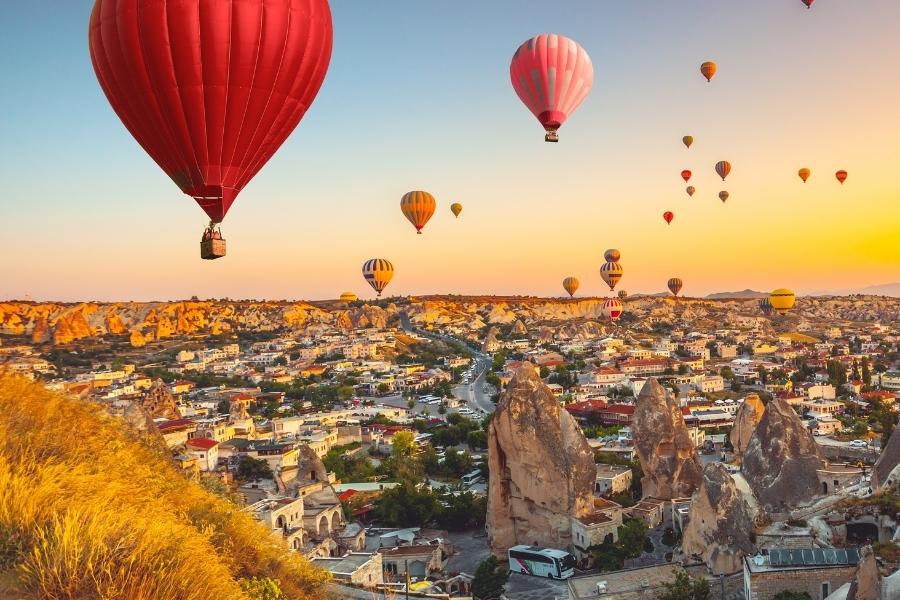
Cappadocia is famous for its surreal fairy chimneys, spectacular hot air balloon rides at sunrise, ancient underground cities, and rock-cut cave churches adorned with Byzantine frescoes. Located in central Turkey, this UNESCO World Heritage region draws over 3 million visitors annually with its one-of-a-kind volcanic landscape that has been shaped by millions of years of erosion and centuries of human habitation. If you’re planning your first visit, this complete guide covers everything Cappadocia is famous for and how to make the most of your trip.
Quick Facts About Cappadocia
- Location: Central Anatolia, Turkey — roughly 730 km southeast of Istanbul
- Nearest airports: Nevşehir Kapadokya Airport (NAV) and Kayseri Erkilet Airport (ASR)
- UNESCO status: Göreme National Park and Rock Sites of Cappadocia — inscribed in 1985
- Best time to visit: April–June and September–November for mild weather and clear skies
- Average balloon ride cost: €150–€300 per person (2024–2025 prices)
- Underground cities discovered: Over 200, with Derinkuyu being the deepest at 85 meters
- Annual visitors: Approximately 3.8 million in 2023
What Is Cappadocia Famous For?
Cappadocia’s fame rests on a rare combination of geological wonder, ancient human ingenuity, and modern-day adventure tourism. Few places on Earth offer the chance to float over a moonscape in a hot air balloon at dawn, explore cities carved eight stories underground, and sleep inside a cave hotel — all in the same trip.
The region spans several towns and valleys across the provinces of Nevşehir, Kayseri, Aksaray, and Niğde. Its landscape was formed roughly 60 million years ago when volcanic eruptions from Mounts Erciyes, Hasan, and Güllüdağ blanketed the area in thick layers of ash and tuff. Over millennia, wind and water sculpted this soft rock into the towering pillars, cones, and mushroom-shaped formations that visitors marvel at today.
Why Are Cappadocia’s Fairy Chimneys So Unique?
The fairy chimneys — called peri bacaları in Turkish — are Cappadocia’s most iconic natural feature. These tall, cone-shaped rock formations are topped with harder basalt caps that protected the softer volcanic tuff beneath from erosion, creating their distinctive “mushroom” or “chimney” silhouettes.
You’ll find the most impressive fairy chimneys in these locations:
- Paşabağ (Monks Valley): Home to multi-headed fairy chimneys and a hermit monk’s chapel carved inside one of them
- Devrent (Imagination) Valley: Features animal-shaped rock formations — look for the famous camel rock
- Love Valley: Known for tall, pillar-shaped chimneys that can reach up to 40 meters in height
- Urgüp Fairy Chimneys: The iconic trio of chimneys featured on countless postcards
What makes these formations truly unique is that early inhabitants didn’t just admire them — they carved homes, churches, storage rooms, and even pigeon houses directly into the rock. This marriage of nature and human creativity is what earned the region its UNESCO designation.
What Makes the Hot Air Balloon Experience So Special?
If there’s one image that defines modern Cappadocia, it’s the sight of hundreds of colorful hot air balloons drifting over fairy chimneys at sunrise. This experience has become one of the most photographed moments in the world, and for good reason.
Cappadocia’s unique topography creates exceptionally stable air currents at dawn, making it one of the safest and most reliable balloon-flying destinations globally. On a typical morning during peak season, up to 150 balloons can take to the sky simultaneously.
What to know before you book:
- Duration: Flights last approximately 45–60 minutes, but expect 3–4 hours total including pickup, inflation, and celebration
- Capacity: Standard baskets hold 16–24 passengers; smaller “VIP” baskets carry 8–12
- Best months: May through October have the highest flight success rates
- Cancellations: Flights are regulated by the Turkish Civil Aviation Authority and are cancelled in poor weather — always budget an extra day in case
- Booking tip: Reserve at least 2–3 weeks in advance during summer and always choose a licensed, experienced operator
The balloon ride typically lifts off about 30 minutes before sunrise. You’ll float over Göreme National Park, Rose Valley, Pigeon Valley, and the fairy chimneys, watching the landscape transform as golden light spills across the valleys. Most operators finish with a champagne toast and a flight certificate.
How Deep Do the Underground Cities Go?
Cappadocia is home to more than 200 underground cities, a staggering network of subterranean settlements that served as hiding places during times of invasion and religious persecution. The two most famous — and most visited — are Derinkuyu and Kaymakli.
Derinkuyu Underground City
Derinkuyu is the deepest explored underground city in the world, descending approximately 85 meters (280 feet) across eight discoverable floors. It could shelter an estimated 20,000 people along with their livestock and food supplies. Inside, you’ll find ventilation shafts, water wells, kitchens, wineries, churches, and even a missionary school.
The city’s massive stone doors — circular rolling stones weighing up to 500 kg — could only be closed from the inside, providing formidable defense against invaders. Historians believe the earliest tunnels were carved by the Phrygians in the 8th–7th centuries BCE, with significant expansion during the Byzantine era when Christians sought refuge from Arab raids.
Kaymakli Underground City
Kaymakli is the widest underground city in Cappadocia, with four of its eight floors open to visitors. It features a more complex, maze-like layout than Derinkuyu and is connected to it by an underground tunnel stretching roughly 9 kilometers. The two cities are only about 10 km apart above ground.
Practical tips for visiting:
- Admission is approximately 450–600 TL per person (prices update seasonally)
- Passageways can be narrow and low — wear comfortable shoes and avoid heavy backpacks
- Visit early morning (before 10:00 AM) to avoid tour group congestion
- If you’re claustrophobic, Kaymakli’s wider tunnels may be more comfortable than Derinkuyu’s
What Can You See at Göreme Open-Air Museum?
The Göreme Open-Air Museum is the crown jewel of Cappadocia’s cultural heritage and one of Turkey’s most important Byzantine sites. This monastery complex contains over 30 rock-carved churches and chapels dating from the 10th to 13th centuries, many adorned with vivid frescoes depicting biblical scenes.
Highlights include:
- The Dark Church (Karanlık Kilise): Home to the best-preserved frescoes in Cappadocia — the lack of light actually helped protect the pigments for nearly a thousand years. Note: there’s a separate admission fee of approximately 150 TL.
- The Apple Church (Elmalı Kilise): Features beautifully detailed scenes from the life of Christ
- The Snake Church (Yılanlı Kilise): Named for its depiction of St. George slaying a dragon (often mistaken for a snake)
- The Buckle Church (Tokalı Kilise): Located just outside the main complex, this is the largest church in Göreme with stunning indigo-blue frescoes
Allow at least 1.5–2 hours for your visit. The museum is located just 1.5 km from Göreme town center and is easily walkable. Audio guides are available and highly recommended for understanding the rich theological and artistic significance of the frescoes.
Why Should You Stay in a Cave Hotel?
Sleeping in a cave hotel is one of Cappadocia’s most iconic experiences — and it’s far more luxurious than it sounds. Many of the region’s best accommodations are carved directly into the rock, combining ancient Cappadocian architecture with modern comforts like heated floors, rain showers, and plush king-size beds.
Cave hotels range from budget-friendly guesthouses starting around €40 per night to ultra-luxury boutique properties exceeding €500 per night. Most are concentrated in Göreme, Uçhisar, and Ürgüp.
Tips for choosing your cave hotel:
- Request a room with a terrace if you want to watch the morning balloon launch from bed
- Uçhisar offers the most panoramic views from its elevated position
- Göreme is best for walkability and budget options
- Ürgüp tends to attract couples and honeymooners with its quieter, more refined atmosphere
What Outdoor Adventures Can You Experience?
Beyond balloons and underground cities, Cappadocia is a paradise for outdoor enthusiasts. The region’s diverse valleys offer experiences you won’t find anywhere else in Turkey.
- Hiking the Valleys: Rose Valley and Red Valley offer stunning 2–3 hour hikes through pink-hued rock formations. Ihlara Valley, a 14-km canyon carved by the Melendiz River, features over 100 rock churches along its walls.
- ATV and Quad Tours: Explore the valleys and fairy chimneys off-road, typically lasting 1–2 hours and costing €30–€60 per person.
- Horseback Riding: Cappadocia’s ancient name comes from the Hittite word Katpatuka, meaning “Land of Beautiful Horses.” Riding through the valleys is a poetic way to honor that heritage.
- Mountain Biking: Several operators offer guided rides through Sword Valley, Love Valley, and Pigeon Valley with bike rental and helmet included.
- Pottery in Avanos: The town of Avanos has been a ceramics center since Hittite times, thanks to the red clay of the Kızılırmak (Red River). Many workshops offer hands-on pottery classes lasting 30–60 minutes.
When Is the Best Time to Visit Cappadocia?
Cappadocia experiences a continental climate with hot, dry summers and cold, snowy winters. Each season offers a different experience:
- Spring (April–June): Ideal weather (15–25°C), wildflowers in bloom, fewer crowds than summer. Best overall time to visit.
- Summer (July–August): Hot (up to 35°C) and crowded, but longest daylight hours and highest balloon success rate.
- Autumn (September–November): Mild temperatures, golden light, grape harvest season. Excellent for photography and hiking.
- Winter (December–February): Cold (down to -10°C) with snowfall. Fairy chimneys dusted in snow are breathtaking, prices are lowest, and balloon rides over white landscapes are magical — but cancellation rates are higher.
How Do You Get to Cappadocia?
Most first-time visitors arrive by air or organized tour. Here are your main options:
- By air: Fly to Kayseri (ASR) or Nevşehir (NAV) from Istanbul — flight time is about 1 hour 20 minutes. Both airports are 45–75 minutes from Göreme by shuttle.
- By bus: Overnight buses from Istanbul take approximately 10–11 hours and cost around 500–800 TL. Comfortable but long.
- By organized tour: Multi-day Turkey tours from gallipolitour.com often combine Cappadocia with Istanbul, Pamukkale, and Ephesus for a seamless experience.
Once in Cappadocia, getting around is easiest by rental car, organized day tours, or local minibuses (dolmuş) that connect Göreme, Ürgüp, Avanos, and Uçhisar.
Frequently Asked Questions
How many days do you need in Cappadocia?
A minimum of 2 full days allows you to experience a balloon ride, visit the Göreme Open-Air Museum, and explore an underground city. However, 3–4 days is ideal if you want to hike the valleys, take an ATV tour, visit Avanos for pottery, and have a backup day in case your balloon flight is weather-cancelled.
Is Cappadocia worth visiting without a hot air balloon ride?
Absolutely. While the balloon ride is iconic, Cappadocia’s underground cities, cave churches, hiking valleys, and unique accommodations are extraordinary experiences on their own. You can also watch the balloons from the ground at sunrise viewpoints in Göreme — it’s spectacular and completely free.
Is Cappadocia safe for solo travelers and women?
Yes. Cappadocia is one of the safest tourist destinations in Turkey. The towns are small, locals are welcoming, and the tourism infrastructure is well-developed. Solo female travelers regularly visit without issues, though standard travel precautions always apply.
What should I wear when visiting Cappadocia?
Wear sturdy, comfortable walking shoes — the terrain is rocky and uneven, especially in the valleys and underground cities. Dress in layers, as mornings can be chilly even in summer (especially during balloon rides at altitude). There’s no specific dress code for the outdoor sites, though modest clothing is respectful when visiting cave churches.
Can you visit Cappadocia as a day trip from Istanbul?
It’s technically possible with an early morning flight and late return, but it’s not recommended. The travel time eats into your experience, and Cappadocia deserves at least two full days. A much better option is a multi-day guided tour from Istanbul that includes flights and accommodation.
Ready to Experience What Cappadocia Is Famous For?
Cappadocia is one of those rare destinations that exceeds even the highest expectations. From floating over fairy chimneys at sunrise to wandering through underground cities that sheltered civilizations for thousands of years, this is a place that stays with you long after you leave.
Whether you’re planning a romantic getaway, a solo adventure, or a family holiday, our team at gallipolitour.com can help you design the perfect Cappadocia experience — including flights, cave hotel stays, balloon rides, and guided excursions. Browse our Cappadocia and Turkey tour packages or reach out to our travel experts today. Your fairy tale in the fairy chimneys is waiting.